


 |
| Mixed-media painting by Nadia Trinkala at Fulton Street Gallery |
There are two major transitions under way in Troy’s arts institutions, with tearful departures and joyous events tied together. The local news has carried much coverage of the decision of the Arts Center of the Capital Region’s president, Amy Williams, to step down and enter the private sector – and her going-away party at the Arts Center on Thursday drew a huge crowd of friends who were happy to share their appreciation of Williams’ leadership over the decades and to wish her well.
I was a willing part of that throng, as a close follower of the ACCR’s activities since my association with it in the early 1980s, when it was known as the Rensselaer County Council for the Arts and I was a member of its board of directors. At that time, the RCCA established a budget line for a paid Exhibits Coordinator (before that it was a volunteer position), and Williams was the first person hired to fill that post - part time, at $1,600 a year. She and the Arts Center have come a very long way since then, and I wish them both more great progress in the future.
The other big news in Troy is that the long-struggling Fulton Street Gallery is slated to close – but I have it from a reliable source that, instead, it will remain open under new management, with founding Director Colleen Skiff stepping away but continuing to present art under the Fulton Street name at the Uncle Sam Atrium.
This is exciting for many reasons, not least of which is that it means the current Fulton Street exhibition of work by (or inspired by) Nadia Trinkala will continue through the month of August (hours yet to be determined). It is an extraordinary exhibition of very high quality, made all the more touching by the fact of its protagonist’s suicide this spring (click here to see GV’s In Memoriam for Trinkala).
To anyone who may have doubted Trinkala’s credibility as an artist, this exhibition is a revelation. Comprising work in several media – photography, drawing, painting, jewelry, and more, all of it sensitive, revealing, well-made, and consistent with a personal vision – the show does her memory justice. Trinkala’s dear friends Ray Felix and Robert Gullie made it happen, and they did an outstanding job of curation, preparation, and installation, producing a finely coherent whole that uses the Fulton Street location perfectly, and underscores the importance of keeping this ideal storefront space open as a gallery.
Meanwhile, back at the ACCR, the Fence Salon will come down on Saturday (July 17), to be replaced by the reconfigured Fence Select, which will open on July 29 (along with a solo show in the President’s Gallery by John Yost, a photographer and video artist who earned his MFA at UAlbany this spring). An annual juried show open to all artist members of the ACCR without an entry fee, the Fence Show’s 44-year history and broad appeal qualifies it in my estimation as “the other Regional,” and this year’s lineup fulfills that expectation with strong work in many media, selected by Hudson gallerist Carrie Haddad.
Viewing the hundreds of entries in the Salon, where those that were selected by Haddad are mixed in but designated by a paper marker, I found myself nodding in agreement over and over again. “Yes,” I found myself thinking, “she’s nailing it!” That is, until I saw a superb trio of color photographs by Chris DeMarco, and searched in vain for the “selected” card. Did Haddad fail to notice them amid the chaos of the salon? A staffer assured me that she had been thorough in her perusal – and that I was just one of a number of people who had asked the same thing on DeMarco’s behalf. So it goes with juried shows.
As it happens, the Fence Show had strangely few photography submissions this year. I have no way of knowing why that would be (it has attracted work from numerous fine photographers in the past), but I wonder if the overlap with the Photography Regional (at Albany Center Gallery through July 16) had an effect – or if the fact that Haddad judged that exhibition in Troy just last year (under Fulton Street’s auspices in the Atrium) made some photographers decide not to bother.
Aside from that, I think we can expect the installed Fence Select to be high quality and well representative of the art that this region has to offer. As for the true Regional, which recently opened at the Albany Institute of History & Art, watch this space for a review to run soon.


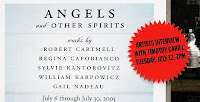 in July 2005 and he gave us one. The show was called "Angels and Other Spirits," and also included Bob Cartmell, Regina Capobianco, Sylvie Kantorovitz, and Gail Nadeau. (Here's a picture of the artist interview by Timothy Cahill - that's Tim on the left and Bill on the right.)


