Hot Images1Hot Images2Hot Images3Hot Images4Hot Images5
Showing posts with label Williamstown. Show all posts

Friday, July 29

Reflections on a Museum at WCMA

Edward Hopper - Morning in a City 1944
I've been saying for years that the Williams College Museum of Art, a personal favorite of mine, gets wrongly overlooked because it is next door to the much larger Clark Art Institute and the even bigger MASS MoCA is just a few miles down the road. Now, this imbalance may be even more extreme - that is, the WCMA, after a recent whole-museum re-installation of the collection, is even more deserving of the attention its neighbors easily gain.

Unknown artist, Gabon 20th century
Mbulu-Ngulu (reliquary figure)
To call Reflections on a Museum a revelation is understatement, because it is by design and intention both revealing and enlightening. Augmented by 50 choice pieces on loan through a collection-sharing initiative from the Yale University Art Gallery, this sweeping and thoughtful series of eight exhibitions allows the viewer to get inside the art-making and collecting processes with gentle help from the WCMA's able curatorial staff (and others), but without intrusive label copy or - worst of all - facile explanations.

Rather, the method is to present a remarkably wide range of objects in challenging (but not needlessly provocative) juxtapositions, and then to offer questions about the objects, their context, their provenance, and their ultimate placement in these two prominent university collections. The result is a virtual tour of human civilization, guided but open-ended, which features curious side trips that focus on how we experience objects and art. The natural questions that we would ask on such a trip are posted for us, and some potential answers are, too, but it never feels that we are being pandered or preached to.

Unknown artist (Roman)
 late 3rd century
Sarcophagus fragment of Hercules,
Triumph of Dionysos
A detailed analysis of this ambitious and impressive undertaking would be exhausting either to write or read, so instead I will just try to point out some of the highlights and, as the curators did, leave you to seek your own experience and draw your own conclusions.

Then again, a friend who accompanied me on this visit, and who is a lifelong art lover now past 70 years old, proclaimed about halfway through our tour that Reflections on a Museum is probably the best museum exhibition he has ever seen. So there's a ringing endorsement if I ever heard one.

Two years in the making, the exhibitions began opening in staggered fashion in April and will remain on view through next June. The scale of the project, and the museum's free admission policy, will surely encourage multiple visits, as will The Gallery of Crossed Destinies, where 25 objects are being installed differently by four different guest curators in sequence through 2011; and the Room for Reflection, where a single work of art is showcased each month (through December).

Robert Wilson
Bridge Chair
with Shadow 
1999
The current iteration of Crossed Destinies presents its intriguing cross-section of objects as interpreted by Jenny Gersten, the new artistic director of the Williamstown Theater Festival. Titled Expressions, this installation of ancient through modern items is arranged in a way that suggests theatrical dialogue and embellished with quotes from plays. The piece on view in the Room for Reflection was a dazzling glass and ceramic mosaic by Maurice Prendergast titled Fiesta Grand Canal Venice - I say "was" because I'm assuming there will be something new there as of Aug. 1.

The museum's first-floor galleries introduce the concept of the exhibitions with a show titled The Object of Art. Here, essential questions are posed: How does art start? What is it? What is it doing here? and so on. The two galleries contain a great variety of objects, from the plainly utilitarian to the utterly conceptual, and we are encouraged to consider them in relation to each other and in relation to our own thoughts, freely formed or inculcated, about what their object may be.

In one fine pairing, a work of art that is a door (by Jim Dine) sits next to a door that is a work of art (anonymously carved granary door from 19th- or 20th-century Mali). The wall text reads "Q. When is a door not a door? A. When it's a work of art." The beauty of this presentation is that it leaves it up to the viewer to consider how this Q&A may apply to the particular doors on the wall, and to recognize that intention and context both determine the meaning of an object and are mutable. Not incongruously, a complex collector's item that consists of a miniature museum-in-a-box of Marcel Duchamp reproductions sits nearby.

Wybrand Simonsz de Geest the elder
Portrait of a Man 1630
The next room is dominated by four portraits - a pair of paintings depicting a prosperous 17th-century Dutch couple, and a pair of glossy photographs depicting an estranged, poor, 21st-century South African couple. All four portraits are effective and revealing on their own but, facing off, they raise many important issues, not least of which is the fact that the Dutch were colonizing South Africa in the 17th century, and the legacy of that exploitation remains there today. Meanwhile, these four faces also remain as bookends to that history.

Zwelethu Mthethwa - Untitled 2006
The subsequent upstairs galleries begin with a large exhibition titled The Medium and the Message, where the same sort of extreme range is attenuated but still reiterated in books, prints, photographs, paintings, sculptures and more, all of which form part of an ongoing dialogue about material and process. Here, a painting by Joseph Marioni was part of the focus for a gallery talk by outgoing Deputy Director and Chief Curator John Stromberg on the color red that also brought us to paintings by Chester Harding and Grant Wood in the next gallery, and by Philip Guston in the one beyond that.

Stromberg, working his last day at the WCMA before departing for Mount Holyoke, made a compelling case for his favorite color, and for its use in the works cited. He also makes, in a short and humbly placed "Curator's Voice" text panel in a gallery dedicated to Cosmopolitan Modernism, a compelling case for the entire Reflections on a Museum exhibition and the spirit behind it. He writes, "I feel that objects have a kind of 'bill of rights': They deserve to be cared for, displayed to best advantage, and interpreted in ever-changing combinations that keep them alive conceptually."

Reflections on a Museum lives up to that credo.

Additional sections of the installation are: Don't Fence U.S. In: Crossing Boundaries in American Art; Art Re: Art; A Collection of Histories; and an Artist's Project by artist-in-residence Jesse Aron Green.

Rating: Must See


Grant Wood - Death on Ridge Road 1935
Note: Special thanks go out to Lee at The Daily Grind in Albany for Internet access, without which this review could not have been posted.

Thursday, July 7

Pissarro’s People at the Clark Art Institute

Jeanne Pissarro, called Cocotte, Reading 1899 - Oil on canvas 22 x 26 3/8 in.
With a museum like the Sterling and Francine Clark Art Institute just down the road, you can tend to get a little spoiled. Every summer for as many as I can recall, the Clark has had a show good enough to top my list of the year’s best: Last year, it was Picasso Looks at Degas; the year before, it was Dove/O’Keeffe; and so on, going back (at least) to 2003’s amazing show of J.M.W. Turner’s late paintings.

This year is no exception: Pissarro’s People is a superb exhibition that brings together a wide range of the artist’s work in unique combinations for a once-in-a-lifetime opportunity. Though it probably won’t draw huge crowds like Picasso or O’Keeffe (and that’s a shame), this exhibition offers rewards beyond the woozy feeling you get when confronted by genius on canvas, largely by telling a whopper of a true story.

The Little Country Maid 1882
Oil on canvas 25 x 20 7/8 in.
In effect, Camille Pissarro’s life and career were so fascinating as to almost overshadow the art itself – born half Jewish and half French in Danish-held Saint Thomas in 1830, he goes on to establish and lead the Impressionist movement and to personally mentor Modernism’s two key founders (Paul Cezanne and Paul Gauguin), all the while adhering to a lifelong anarchist philosophy and raising a brood of eight devoted children.

This amazing story is illustrated, so to speak, by Pissarro’s many paintings and works on paper in the show – a thin slice of his life’s work, really, due to the “people” theme. The works also nicely delineate the artistic process in effective ways. And, along the way, they happen to include enough eye-popping masterpieces to keep even the hungriest sensation-seeker satisfied.

As one of those types myself, I might have preferred an arrangement where just the 10 or 12 knockouts were grouped in a room and the rest of the lesson could be left for the more academically inclined – but that’s not what curators tend to do. Anyway, the lesson is more than worth the trouble, and so is the process of hunting down the best stuff in this selection.

Washerwoman, Study 1880
Oil on canvas 28 3/4 x 23 1/4 in.
Among those standouts is a later painting that’s hung in the first gallery (the show’s organizing principle is based on subject, not chronology), and which all alone would be sufficient to nail down Pissarro’s position among the most important painters of his time. That 1899 painting of one of the artist’s daughters, titled Jeanne Pissarro, called Cocotte, Reading (shown at the top of this post), forms a bridge across the two centuries of Pissarro’s life (he died in 1903), and provides a template for the full-blown Modernism of similar work done by Henri Matisse just a few years later. It’s not surprising that such a piece is in the private collection of Ann and Gordon Getty, he the heir to the oil fortune that funded the family’s sprawling Los Angeles museum.

Cocotte, Reading is part of the exhibition’s first section, labeled Family and Friends (an overview with very informative text and just a few exemplary paintings is provided on the museum’s main floor, while the body of the exhibition is upstairs). Several other fine works are in this section, including many portraits of all generations of the family, and one of Cezanne, in etching, that captures the younger artist’s intensity.

One immediately understands from this grouping that there was not a separation of the personal and the professional for Pissarro, a fact that is reaffirmed throughout the rest of the exhibition. Indeed, his personal, familial, and political philosophies all blended to create a powerful approach to picture-making.

Beyond family, the most represented people in Pissarro’s world are servants, workers, and market-goers; the equal footing each has been given shows their portrayer’s deep commitment to the humanism that was spawned by his early Moravian schooling.

Peasant Woman Lying in the Grass, Pontoise 1882
Oil on canvas 25 3/8 x 30 3/4 in.
Pissarro expressed this equality upon the backdrop of a utopian world of rural work and rural leisure. One fine example is an oversized tempera painting, on loan from a museum in Tokyo, titled The Harvest (and shown at the bottom of this post). It is a fine painting, but the show makes it even better by offering a special treat in the form of several graphite-and-wash studies, which were the basis for some of the figures in the painting, on view nearby.

These and many other studies throughout the exhibition provide similar insights into the artist’s working process, as well as the additional excitement that comes from knowing he never exhibited them himself – most were preserved by family members – but that we have the privilege of seeing them now in a new context.

Leisure is captured best in another outstanding painting, titled Peasant Woman Lying in the Grass, Pontoise, where the pleasure of resting in the sun is as palpable as the countless brushstrokes that build the image. Though not yet Pointillist, this painting prefigures the scientific approach to dots of color that Pissarro would soon immerse himself in. Much of the work to follow would be done in that almost ecstatic style; but, for me, it was a digression that lacks the pure energy and emotion of the work he did both before and after.

Pissarro’s People continues at the Clark through Oct. 2.

Rating: Must See

Note: Also at the Clark are two exhibitions of contemporary art that are both well worth seeing. Ghanain sculptor El Anatsui has three monumental works on view in the Stone Hill Center through Oct. 16; and Spaces: Photographs by Candida Höfer and Thomas Struth is on view in the main collection area through Sept. 5 (filling space that was liberated by an international tour of a large group of the museum’s Impressionist holdings).

Robin Kelsey, Shirley Carter Burden Professor of Photography, Harvard University, will present a gallery talk on Spaces at 12:30 p.m. on Wednesday, July 13. The talk is free with admission.

The Harvest 1882 - Tempera on canvas 27 11/16 x 49 9/16 in.

Thursday, May 5

Curators Beware!

In an odd coincidence, on the same day last week that a card arrived in my mailbox publicizing an exhibition at the Munson-Williams-Proctor Art Institute that was curated by high school students, an item appeared in the Times Union about a series of shows at the Williams College Museum of Art that will be curated by non-professionals, including a florist, an athletic coach, and - you betcha! - some high school students.

Now, it so happens that the MWPAI and the WCMA are two of the most respectable museums within the sound of this blog, and they both have especially important and large collections. So it's almost guaranteed that Follow the Light at the MWPAI (already open, and set to run through July 7) and The Gallery of Crossed Destinies, as the WCMA series is titled (and which currently features the curatorial efforts of a group of 9th-graders), include high-quality and intriguing art that will satisfy and inspire viewers.

But what does this say to the rest of us - especially those who either have worked very hard to develop the ability and credibility to organize art exhibitions, and those who respect and admire them - about the value of curatorial sensibility and expertise?

Not to overreact - Follow the Light is the result of a course in Exploring Museum Careers, and The Gallery of Crossed Destinies provides the same carefully selected 25 objects to each of the participants to install in their own way (an Edward Hopper and a Georgia O'Keeffe among them), so there is some control here - but I do have some doubts about this trend.

Why not try this next time: Assign a number to each of the objects in the WCMA collection (let's say there are 3,000 of them), and then use a computer to generate 25 random numbers between 1 and 3,000 - and then have that be your show, curated by ... I don't know, anybody got a clever name for a computer program that curates?

Probably would be a huge draw.

Friday, July 23

Picasso Looks at Degas at the Clark Art Institute

It's the much anticipated, must-see exhibition of the season, and Picasso Looks at Degas at the Sterling and Francine Clark Art Institute does not disappoint. Having brought together a stellar selection of masterpieces and lesser-known curiosities from around the globe, for an exhibition that will not be seen elsewhere in North America at any time, the Clark has an unqualified triumph on its hands.

Who cares if the thesis of the show is little more than an academic footnote to these two artists' transcendent careers? Any excuse to put such treasure a short drive from my backyard is good enough for me! There's no doubt many people from much further away than that will be more than delighted to come and sip from the deep well that Edgar Degas and Pablo Picasso plunged into, separately but similarly, well over a century ago.

Not that the show's thesis is meaningless or mistaken. Picasso, the great, self-described thief, stole freely and gleefully from the master of his father's generation, in whom he clearly recognized a kindred spirit. His earliest work follows a markedly similar trajectory as that of Degas, and his latest work directly imitated and celebrated a specific series of prints by Degas, posing Degas himself as their protagonist. Point made.

A problem with the exhibition is that it begins by forcing juxtapositions one could find in almost any two serious artists' early work - nude studies, self-portraits and the like - which slightly undermines the almost astounding connections revealed later on. Equally, one grows tired of the repetition of the concept, which becomes an insistent drumbeat that won't let up. Degas painted his sister - Picasso painted his sister; Degas hung out with folks in cafes - Picasso hung out with folks in cafes; Degas loved women - Picasso loved women; and so on and on. We get it, and after a while we get sick of it.

But we don't get sick of the art. Expertly and beautifully installed in five galleries (one downstairs, the rest above), delectable tidbits from private collections join celebrated works in a well-calibrated crescendo of knockout groups and juxtapositions (the show was co-organized by the Clark and the Museu Picasso in Barcelona, both of which contribute many works from their collections).

Colors are carefully employed for maximum effect - the largest space (nicely broken up by angled walls) is painted a creamy white, creating an open flow for works in extremely diverse media and every scale, from tiny drawings to large paintings and sculptures. The other spaces, in dark gray, sage green, and carmine, create intensity and intimacy for the more concentrated themes of the early years, the dance, and the brothels.

Hindered only by the unavoidable hips and elbows of the crowd, a viewer can revel in this smorgasbord of brilliant work depicting nude bathers, dancers, denizens of Parisian nightlife, domestic servants, and the artists' friends and family members. Everywhere are signs of riveted attention and masterful ability. Both Degas and Picasso started out strong and remained strongly committed, constantly honing their ideas and techniques while allowing their native skills with line, form, and color to flourish.

The result is an orgy of lush viewing pleasure (not to mention a goodly amount of actual orgiastic activity being depicted in it). Of the particular joys that abound in this exhibition, I must point out one very large Degas painting of a woman after the bath - monochromatic, it displays his exquisite lines and compositional massing with almost total carelessness, leaving the observer weak with gratitude that the master kept the piece mysteriously unfinished.

Most of the other highlights of the show come in pairs. A Degas cafe scene (borrowed from the Musée D'Orsay in Paris) joins a similar Picasso from his blue period (on loan from the Los Angeles County Museum).

Two paintings, each titled Woman Ironing, demonstrate the direct influence of Degas on Picasso; that of the former, painted at the height of Impressionism and having been displayed in a gallery that Picasso frequented, became the template for Picasso's 1904 effort, a grippingly modern interpretation. Their permanent homes, at the National Gallery in Washington, D.C., and the Guggenheim Museum in New York City are relatively close together, but not exactly side by side as one sees the pieces in this exhibition.

Nearby, two exquisite portraits hanging politely distant on a large wall, are strikingly similar - in this case, not because Picasso had previously seen the Degas, but because each artist was strongly influenced by the Spanish painter Francisco Goya in making it.

And in the highlight of highlights, equal-sized paintings in cleverly contrasting colors face off on the white gallery's last big wall, with plenty of room to let them breathe. Degas' is horizontal and shows a woman combing her daughter's thick, red hair. Now part of the collection of The National Gallery in London, this gorgeous painting once belonged to Picasso's friend Henri Matisse, at whose home he surely had the opportunity to study it.

Picasso's response, a vertical 1952 painting on loan from a private collection, is done in grays and blues in his signature mature style and displays a statuesque woman wringing her hair. Just being able to exploit the unique opportunity to peruse and compare these two pieces directly is well worth the $15 seasonal price of admission to the Clark.

Picasso Looks at Degas is open every day (closed Mondays after Aug 31) and remains on view through Sept. 12. Also of interest is a rare installation at the Clark of contemporary art by the recently deceased Spanish sculptor Juan Muñoz, which places his works in the context of the Clark's permanent collection, as well as in the new Stone Hill Center's galleries.

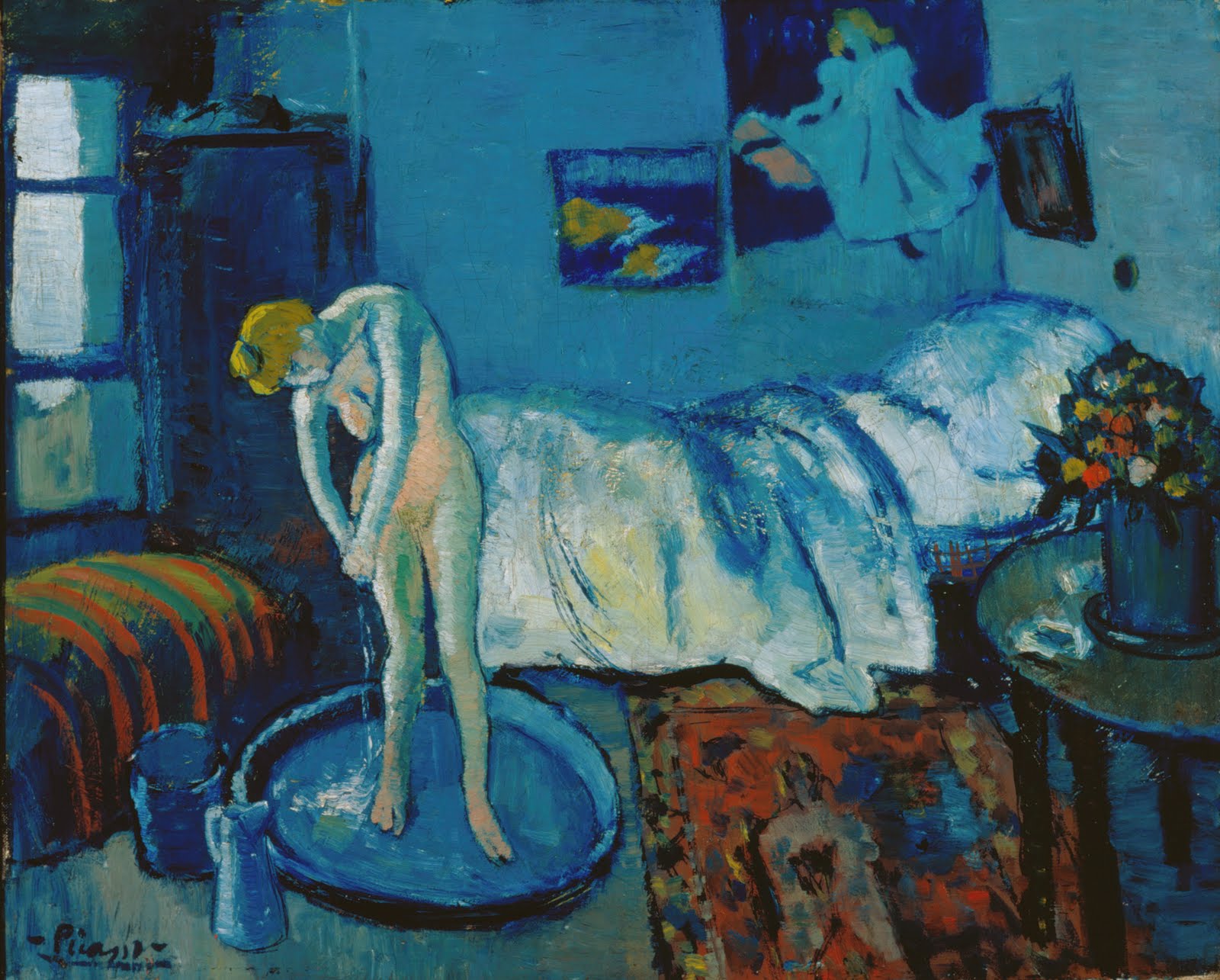
Picture credits, from top and left to right: The Blue Room (The Tub) 1901 by Pablo Picasso; Woman Ironing 1876-1887 by Edgar Degas; Woman Ironing 1904 by Pablo Picasso; In a Café (L'Absinthe) 1875-6 by Edgar Degas; Sebastia Junyer Vidal 1903 by Pablo Picasso; Combing the Hair (La Coiffure) 1892-1896 by Edgar Degas; Nude Wringing her Hair 1952 by Pablo Picasso; Nude Woman Drying Herself 1884-86 by Edgar Degas.

Saturday, August 15

Prendergast in Italy (and more) at WCMA

Maurice Prendergast, Grand Canal, Venice, ca. 1898–99 watercolor and pencil on paper 10 x 13 7/8 inches
Williams College Museum of Art, Gift of Mrs. Charles Prendergast

With all the attention being paid to the Dove/O’Keeffe show at the Clark Art Institute, it could be easy to overlook Williamstown’s other world-class museum, the Williams College Museum of Art. But that would be a grave mistake, especially now, as the WCMA is hosting four exhibitions that are all worth some serious viewing time.

First up is the gorgeous Prendergast in Italy, created in partnership with the Terra Foundation of American Art in Chicago, which draws on the vast Prendergast collection of the WCMA, along with the Terra’s major holdings and several private collections. After it completes its run here on Sept. 20, the show will travel to the Peggy Guggenheim Collection in Venice, Italy, and then in 2010 to the Museum of Fine Arts, Houston.

Prendergast in Italy presents the work of an artist at the top of his game at two distinct points in his career, during travels in Italy in 1898-9 and 1911-12. A consummate craftsman, Maurice Prendergast began as a commercial artist, but then crossed over into fine art after studying in Paris in the 1890s. With his first sojourn to Italy, focusing on Venice as his subject, his success was launched. Always attuned to the development of Modern art, over the next decade Prendergast changed styles; the work of his second sojourn is so different from the first that it is almost like viewing two artists, though the dominant medium throughout is watercolor (to compare, see the images at the top and bottom of this post).

Not to worry: Both are extraordinarily good. The early Prendergast takes an illustrative style and applies it to vividly perceived scenes of Victorian life along the canals. The images are virtually bursting with color, light, and atmosphere (the one reproduced at right is titled Fiesta–Venice–S. Pietro in Volta). Both accurate and expressive, even more than 100 years later they communicate the artist's exuberance at being alive in a place full of stimulation and possibility.

The later work, in keeping with the principles of Modern art, is slightly cooler and more intellectual, even as it is also more primitive. If this seems self-contradictory, consider that Prendergast's main inspiration in adopting the new style came from Paul Cézanne and Henri Matisse. These paintings delight the eye, but don't take you into the action so much as they place you near enough to observe it as a collection of shapes, lines, and tones.

If I could criticize the show, it is that it is perhaps too comprehensive. The two large galleries simply overflow with Prendergast's abundant output. If one is not a fan, it could become tiresome – but for lovers of this artist and period, it is a carnival of marvelous proportions.
Maurice Prendergast, Rialto, Venice, ca. 1911–12 watercolor and pencil on paper
Williams College Museum of Art, Gift of Mrs. Charles Prendergast

Also getting the star treatment at the WCMA is another almost absurdly talented and productive artist, the photographer (and painter) Edward Steichen. Filling a very large gallery almost salon-style is In High Fashion, the Condé Nast Years, 1923-1937. It simply astonishes and overwhelms with the sheer number of masterful portraits of the stars of the day and the groundbreaking fashion pictures that today we take for granted but, when Steichen did them, were a revelation. Again, fans will love it, but others may grow bored. This show ends on Sept. 13.

In a second, smaller gallery, another Steichen show focuses on his personal work. Titled Episodes from a Life in Photography, it features 90 pictures that range from early abstractions (the example above of avocados was made in 1920) to an extended series of landscapes made at Walden Pond, and also includes some commercial images, such as the jazzy 1926 Design for Stehli Silks shown above at right. this show will remain on view through Nov. 8.

Finally, another show of photographs features the work of a Williams alumnus named Ralph Lieberman. While Steichen is a pretty tough act to follow, Lieberman's architecturally inspired black-and-white work holds up very well. Many of the images are classical renderings of their subject matter (such as the one shown here, from San Gimignano in Italy) while others display a more analytical and expressive mind at work. He does Williams proud.

Monday, August 10

Dove/O'Keeffe at The Clark

Arthur Dove, Sunrise I, 1936. Tempera on canvas, 25 x 35 inches.


He inspired Georgia O'Keeffe to begin painting abstractly, became a lifelong friend and ongoing influence on her work, and was celebrated alongside her by the most influential art critics of the first half of the 20th century. Still, though millions of people today can instantly recognize almost any picture by (or of) O'Keeffe, the name Arthur Dove scarcely rings a bell.

But not if Debra Bricker Balken has her way. Balken is the independent curator who created this summer's blockbuster exhibition, Dove/O'Keeffe: Circles of Influence, on view at the Sterling and Francine Clark Art Institute in Williamstown, Mass., through Sept. 7. Balken also put together a Dove retrospective in 1997, and has written the text for the handsome catalog that accompanies this show.

The exhibition at the Clark amply demonstrates both how and why Dove was an artist of similar significance to O'Keeffe, and lovingly documents the depth and duration of their connection. It also features two other players: Alfred Stieglitz, who showed both artists' work at his New York City gallery and introduced them to each other before eventually marrying O'Keeffe; and Sigmund Freud, whose writing on sex greatly influenced the thinking of participants in the American Modernist movement.

O'Keeffe bristled at the characterization of herself and Dove as representative of their respective gender in painting, and I think she was right - the many works by both artists in this show share and swap so many characteristics as to defy any honest viewer who would try to categorize either artist's expression as essentially male or female (to test yourself, take a look at the paintings reproduced above at right and below at left, and then decide which painting is better representative of which sex - they are identified at the bottom of this post).

That debate, I would add, is part of the point. Abstraction, in the hands of Dove and O'Keeffe, became a disembodied celebration of nature, expressed not through the neuroses and complexities of human perceptions, but experienced instead as a pure thing in its forms and essences. What is remarkable about these pioneering paintings is how fresh they seem, and relevant they remain, nearly a century after they were made.

The exhibition does well by presenting the work in bite-size pairs and groupings, and by organizing it into several historical themes (such as New York Modernism) and contextual categories (such as Color/Light). The wall texts are informative, which really helps one to navigate the show conceptually, and succinct, which is practical, as it is likely to be pretty crowded any time you visit. The throngs make it a bit difficult to linger, but it is essential that you take the time to contemplate this art long enough to let it work its magic with your perceptions.

And magical it is. From Dove's stark early drawings, through O'Keefe's groundbreaking watercolors and Dove's experiments with materials such as glass and metal, to the final pairings of the two artists' transcendental nature paintings, it is both a lesson in the history of Modern art and an immersion in the process and power of fully resolved works. While the key to the show is how it works as a whole, both in relating Dove's work to O'Keeffe's and in presenting each artist's work on its own, there are several highlights worth mentioning.

While the larger, finished paintings are very impressive, both artists' watercolor sketches are fascinating, and they provide convenient bookends to the exhibition - O'Keeffe's journey began with hers as she discovered a new style in 1916-17, and Dove's ended with his, as he made one or two tiny personal images each day in the years leading up to his death in 1946.

A room that places two major O'Keeffe cityscapes side by side, and then adds a quieter but compositionally identical Dove nearby, holds enough interest to justify the entire exhibition. Equally, two brilliant Doves (one of which is reproduced at the top of this post) dominate another room, while an understated O'Keeffe pastel titled Slightly Open Clam Shell hangs serenely nearby. Amusingly, the other Dove is titled Alfie's Delight; I will go out on a limb and assert that it's a reference to Stieglitz (who knew they called him Alfie?).

A trio of works by Dove that develop an idea for an image of a stream from a sketch into a fine painting is engrossing and gratifying. On an adjacent wall, two luminous O'Keeffes explore a glowing humanlike form in relation to a vividly green landscape. In this corner of the museum, the presence of the artists is as strong as if we were in their studios the day after these works came into existence.

The entrance to the exhibition, which features a Dove painting of the moon that looks like a towering plant and an O'Keeffe painting of a jack-in-the-pulpit that resembles the Northern lights, sets the proper tone. These are awe-inspiring artists; juxtaposing the two enhances the already powerful experience of seeing their work individually. This fabulous show will not travel - you must see it here and now, and I recommend that you do.

Georgia O'Keeffe, Sunrise, 1916. Watercolor on paper, 8 7/8 x 11 7/8 in.

Gender quiz answers: The painting reproduced above at the right is Georgia O'Keeffe's Red & Orange Streak, 1919. Oil on canvas, 27 x 23 inches (68.6 x 58.4 cm). Philadelphia Museum of Art. Bequest of Georgia O'Keeffe for the Alfred Stieglitz Collection, 1987 [Courtesy of the Philadelphia Museum of Art]. The one below it at left is Arthur Dove's Fog Horns, 1929. Oil on canvas, 18 x 26 inches (45.7 x 66 cm). Colorado Springs Fine Arts Center. Anonymous Gift, FA 1954.1 [Courtesy of and copyright The Estate of Arthur Dove / Courtesy Terry Dintenfass, Inc.].

Additional credits: The painting reproduced at the top of this post is from the collection of Deborah and Ed Shein [Courtesy of and copyright The Estate of Arthur Dove / Courtesy Terry Dintenfass, Inc.]; the one at the bottom is from the collection of Barney A. Ebsworth [(c) 2009 Georgia O'Keeffe Museum / Artists Rights Society (ARS), New York].

Related Posts Plugin for WordPress, Blogger...